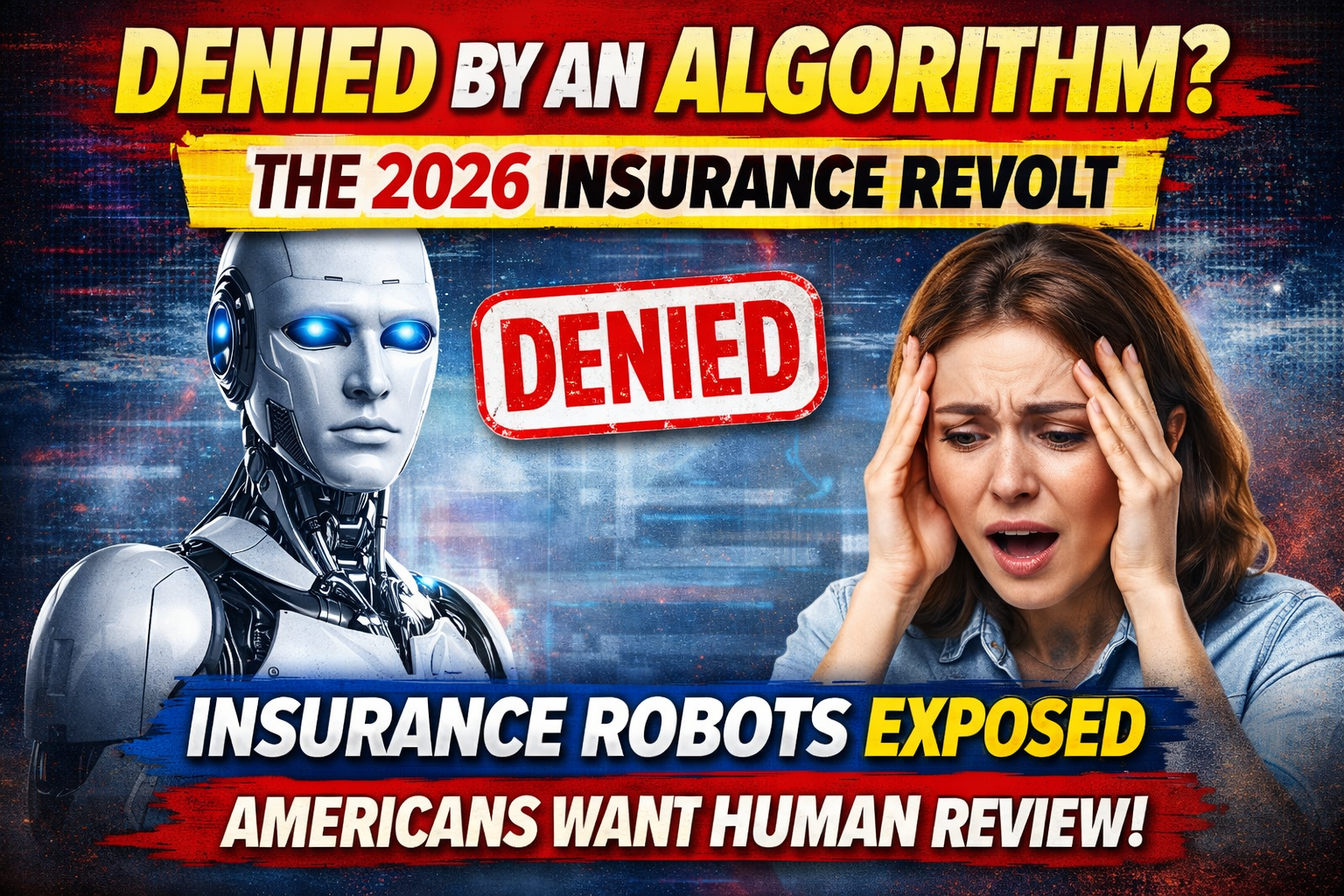
Imagine this.
You file an auto insurance claim after a minor accident in Dallas.
No police dispute.
No injuries.
Clear photos.
Three hours later, you receive an automated email:
“Claim Denied. Risk profile inconsistent.”
No phone call.
No explanation.
No human voice.
Just an algorithm.
Welcome to 2026 — where artificial intelligence is processing insurance claims faster than ever… and Americans are pushing back.
Across the United States, policyholders are asking one powerful question:
“Who decided this — a human or a machine?”
This blog explores:
- What algorithm-driven insurance really means
- Why denial rates feel more automated
- What “Human-in-the-Loop” insurance is
- Real-life US examples
- Legal and ethical concerns
- How consumers can protect themselves
- FAQs people are searching right now
If you have auto, health, homeowners, or life insurance — this affects you.
Let’s unpack what’s really happening.
What Is Algorithm-Based Insurance?
Insurance companies have always used data.
But today, advanced AI models now:
- Evaluate risk scores
- Approve or deny claims
- Flag “fraud indicators”
- Adjust premiums dynamically
- Predict future claim probability
Instead of waiting days for manual underwriting, decisions now happen in seconds.
This shift is powered by machine learning systems that analyze:
- Driving patterns
- Credit behavior
- Location risk
- Shopping data
- Social signals (in some cases)
It’s efficient.
But efficiency isn’t always fair.
What Does “Human-in-the-Loop” Actually Mean?
Human-in-the-loop (HITL) insurance means:
AI makes recommendations.
A human makes the final decision.
Instead of fully automated approvals or denials, a trained insurance professional reviews:
- Edge cases
- High-risk flags
- Complex claims
- Appeals
Americans are increasingly demanding this oversight because algorithms, while powerful, can:
- Misinterpret data
- Amplify bias
- Make errors at scale
- Provide unclear explanations
And when money, homes, or healthcare are involved — errors matter.
Why This Became a National Issue in 2026
Insurance automation accelerated rapidly over the past few years.
Auto claims are now often processed through image recognition systems.
Health claims are filtered by predictive fraud models.
Home insurance pricing incorporates wildfire risk AI forecasting.
But here’s where tension began:
Consumers started noticing:
- Faster denials
- Vague explanations
- Harder appeal processes
- Premium spikes without warning
Social media amplified stories.
State regulators began asking questions.
And suddenly, “algorithm audits” became a trending topic.
Real-Life Scenario: The Arizona Homeowner Case
Let’s consider a realistic example.
Jessica, a homeowner in Phoenix, filed a roof damage claim after a storm.
Drone photos were uploaded.
AI assessed roof condition.
Claim denied within 24 hours.
Reason given:
“Damage appears consistent with normal wear and tear.”
Jessica hired a local contractor for inspection.
Result?
Storm impact damage confirmed.
After escalating to a human claims adjuster, the claim was approved.
But it took 6 weeks.
Her question:
Why wasn’t a human involved from the beginning?
Multiply that scenario across thousands of Americans — and you see why algorithm transparency matters.
The Pros of Algorithm-Driven Insurance
To be fair, automation isn’t evil.
It brings real advantages:
✅ Faster Claims Processing
Minor auto claims can be paid within hours.
✅ Lower Operational Costs
Less paperwork means lower administrative expenses.
✅ Fraud Detection
AI detects patterns humans might miss.
✅ More Personalized Pricing
Drivers with safer habits may pay less.
Efficiency isn’t the problem.
Lack of oversight is.
The Risks Americans Are Concerned About
Here’s where the concern grows.
1️⃣ Bias Amplification
If historical data contains bias, algorithms may replicate it.
For example:
- ZIP code-based pricing
- Socioeconomic risk scoring
- Health predictive modeling
Without human review, bias can become systemic.
2️⃣ Opaque Decisions (“Black Box” Problem)
Many AI systems don’t clearly explain why a decision was made.
Consumers receive:
“Claim does not meet eligibility criteria.”
But what criteria?
Transparency becomes critical.
3️⃣ Appeals Becoming Harder
Automated denials can feel impersonal.
Reaching a real decision-maker may require multiple escalations.
4️⃣ Data Errors at Scale
If a data point is wrong — such as incorrect mileage or claims history — the algorithm may flag risk incorrectly.
And algorithms scale fast.
Why Americans Now Demand Algorithm Audits
An algorithm audit involves:
- Independent review of decision models
- Bias testing
- Transparency checks
- Accuracy validation
- Human oversight requirements
Consumers want:
- Clear explanations
- Human appeal rights
- Bias testing standards
- Disclosure when AI is used
This is not anti-technology.
It’s pro-accountability.
The Financial Impact on Families
Let’s break this down with numbers.
If an AI system increases your premium by 18% due to “risk indicators,” that could mean:
$1,500 premium → $1,770
Over 5 years:
$1,350 extra paid
Without clear reasoning.
For families living paycheck to paycheck, this isn’t theoretical.
It’s survival math.
Human-in-the-Loop: What It Would Look Like
In a balanced system:
- AI reviews claim
- Flags anomalies
- Sends recommendation
- Human adjuster verifies
- Decision finalized
This hybrid model:
- Preserves efficiency
- Adds fairness
- Improves trust
- Reduces regulatory risk
Trust is the real currency in insurance.
Without it, customers switch providers.
Regulatory Pressure Is Rising
Several states are reviewing AI transparency laws.
Policy discussions include:
- Mandatory explanation rights
- AI disclosure requirements
- Consumer audit access
- Bias reporting
As automation grows, oversight grows too.
Insurance companies know this.
That’s why many are proactively adopting human review checkpoints.
The Ethical Question: Should Machines Decide Financial Fate?
Insurance isn’t just a product.
It’s protection.
When homes, vehicles, or medical bills are involved, Americans expect:
- Empathy
- Context
- Judgment
Machines calculate probabilities.
Humans understand nuance.
That difference matters.
How Consumers Can Protect Themselves
If you suspect algorithmic error:
✔ Request Written Explanation
Ask specifically if AI was involved.
✔ Request Human Review
You have the right to escalate.
✔ Check Your Data
Review credit reports and driving records.
✔ Document Everything
Photos, receipts, timestamps matter.
✔ File Complaint if Needed
State insurance departments handle disputes.
Transparency starts with asking questions.
The Business Perspective: Why Insurers Should Listen
From a business standpoint:
Trust = retention
Retention = profitability
If consumers believe machines are unfair, churn increases.
Hybrid oversight models protect both parties.
Smart insurers are adapting early.
The Future of Insurance in America
Expect these trends:
- AI-assisted underwriting
- Human review mandates
- Transparent risk scoring
- Real-time claim dashboards
- Consumer data control panels
Insurance in 2030 will likely be:
Automated — but supervised.
Efficient — but accountable.
FAQ
❓ What is algorithm-based insurance?
It’s when AI systems analyze data to approve, deny, or price insurance policies automatically.
❓ What does human-in-the-loop insurance mean?
It means a human professional reviews or confirms AI-generated decisions before final approval.
❓ Can AI deny insurance claims automatically?
Yes, some systems can issue automated denials, depending on company policies.
❓ Is algorithm bias real in insurance?
Bias can exist if training data reflects historical inequality. Audits help reduce this risk.
❓ How can I challenge an automated denial?
Request a detailed explanation and escalate to a human review through the insurer or state regulator.
Final Thoughts: This Isn’t About AI vs Humans
It’s about balance.
AI is powerful.
Humans are accountable.
Insurance sits at the intersection of money and security.
Americans aren’t rejecting technology.
They’re demanding fairness.
The future isn’t fully automated insurance.
The future is intelligent systems — with human judgment at the final checkpoint.
And in 2026, that demand is only getting louder.