
(The Insurance Price Gap Nobody Warned You About)
If you’re shopping for a new car in 2026, you’re probably asking:
- Should I buy electric?
- Are EVs really cheaper long-term?
- Will I save money every month?
But here’s the question most Americans forget to ask until it’s too late:
How much will insurance cost me — EV vs. Gas?
Because in many cases, the real monthly difference isn’t fuel…
It’s your insurance premium.
Today, we’re breaking down a deep, real-world U.S. comparison of average auto insurance costs in 2026 — electric vs. gas — and why the gap may surprise you.
By the end of this guide, you’ll know:
- Which engine type costs more to insure
- Why EV insurance is often higher
- Where gas vehicles still win
- When EV insurance actually makes sense
- How to lower your premium — regardless of engine type
Let’s start with the numbers.
2026 Average Insurance Cost: EV vs. Gas
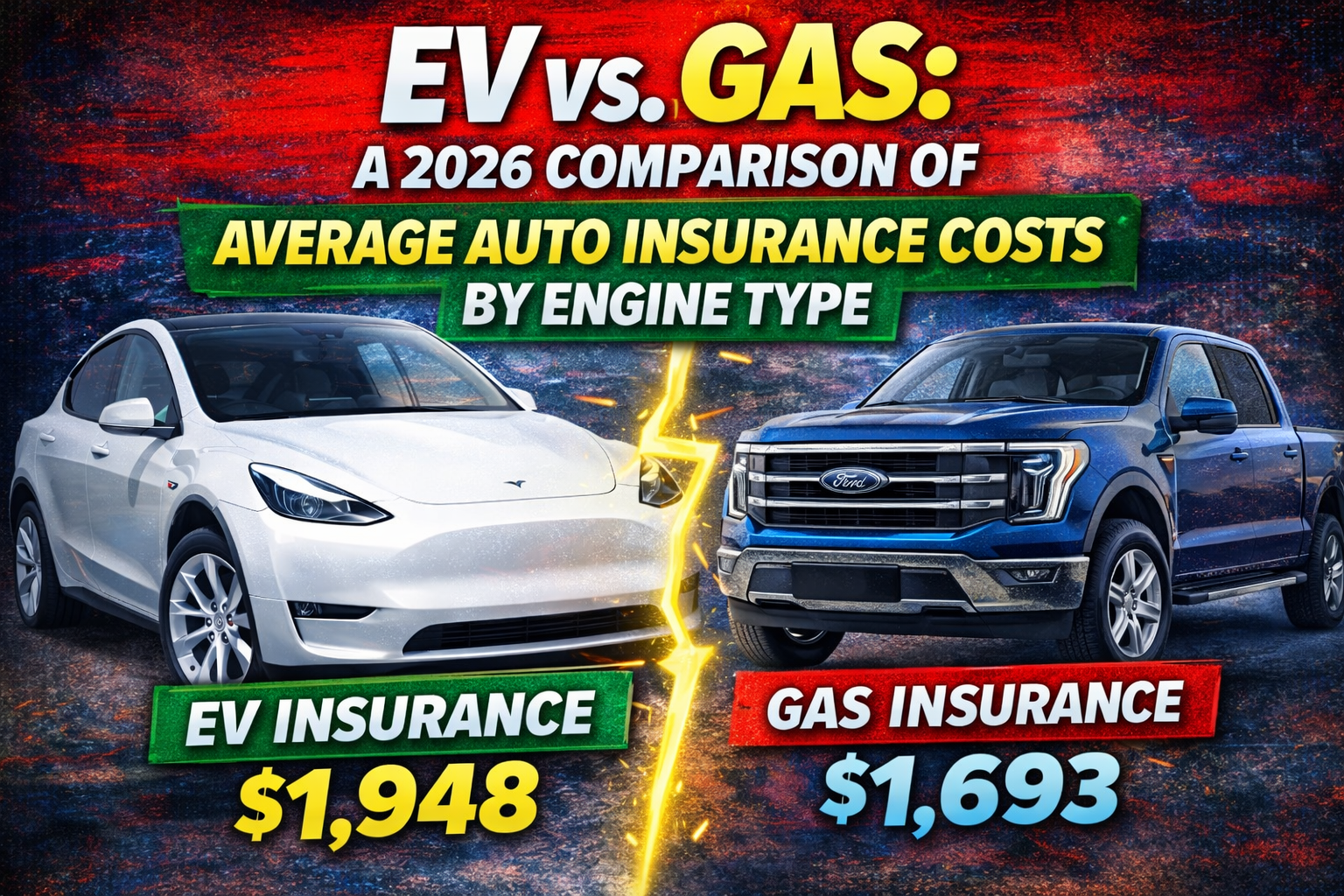
Across the U.S. in 2026, the national average full-coverage auto insurance premium looks like this:
- Gas-powered vehicle: ~$1,650–$1,750 per year
- Electric vehicle (EV): ~$1,900–$2,200 per year
That’s roughly:
👉 $250–$500 more per year for many EV owners
But averages don’t tell the full story.
Because the difference depends heavily on:
- Vehicle model
- Location
- Repair costs
- Driver profile
- Vehicle weight
- Technology inside the car
Let’s break this down properly.
Why EV Insurance Is Often Higher in 2026
1. EVs Cost More to Repair
Electric vehicles are packed with:
- Battery packs
- Advanced sensors
- High-voltage wiring
- Specialized cooling systems
Take popular models like the Tesla Model Y or Ford F-150 Lightning.
Both are loaded with:
- Cameras
- ADAS systems
- Radar modules
- Complex battery platforms
A simple fender-bender can require:
- Sensor recalibration
- Battery inspection
- Software diagnostics
- Certified EV repair technician
Repair bills rise fast.
And when repair costs rise, insurance premiums follow.
2. Battery Replacement Risk
EV batteries can cost:
- $12,000
- $18,000
- $25,000+
Even minor underbody damage can sometimes trigger:
- Full battery replacement
- Or total loss declaration
Gas vehicles?
Engines are expensive — but rarely replaced after small impacts.
Insurers factor that risk into premiums.
3. EVs Are Heavier
Many EVs weigh 4,500–7,000 pounds.
Heavier vehicles mean:
- Greater collision force
- Higher third-party damage
- More severe accident payouts
Insurance companies price risk based on data — and heavier vehicles often mean higher claim severity.
Where Gas Vehicles Still Win
Gas-powered vehicles still hold advantages in insurance pricing because:
- Repair networks are everywhere
- Mechanics are widely available
- Parts are easier to source
- Damage procedures are standardized
For example:
A mid-size gas SUV like the Toyota RAV4 or Honda CR-V may cost significantly less to repair than a similarly sized EV crossover.
That stability keeps premiums lower.
Real-World Example: Suburban Family in Texas
Let’s say a family upgrades from a gas SUV to an EV.
Old vehicle: Gas SUV
Insurance: $1,680/year
New vehicle: Electric SUV
Insurance: $2,180/year
Difference: $500 per year
Fuel savings? Maybe $1,200 annually.
Net savings: $700.
Still positive — but much lower than expected.
That’s the part dealers don’t emphasize.
Urban vs. Rural Insurance Differences
Your ZIP code matters more than your engine.
In Large Cities (Los Angeles, New York, Miami)
EV insurance is often significantly higher due to:
- High repair labor rates
- Expensive parts
- Traffic density
- Higher claim frequency
The EV vs. Gas gap widens in urban environments.
In Rural Areas
The difference may shrink slightly.
However, rural areas sometimes have fewer EV-certified repair centers — which can also raise costs.
Model-by-Model Breakdown (Example Comparison)
Let’s compare similar vehicle categories.
Compact SUV
- Tesla Model Y
- Toyota RAV4
In many states, the EV costs $300–$600 more annually to insure.
Pickup Truck
- Ford F-150 Lightning
- Ford F-150
Electric version typically costs more due to:
- Higher vehicle value
- Larger battery pack
- Specialized repair needs
Luxury Sedan
- Tesla Model S
- BMW 5 Series
Luxury vehicles are expensive regardless of engine.
Here, the insurance gap may shrink because both are high-risk categories.
Are EVs Safer — And Does That Help?
Many EVs score well in crash tests.
Strong battery placement can lower rollover risk.
But insurance pricing is not just about safety ratings.
It’s about:
- Cost per claim
- Repair complexity
- Part replacement price
- Total loss frequency
Even safe vehicles can be expensive to insure if repair costs are high.
Theft & Comprehensive Risk
In 2026:
- Catalytic converter theft impacts gas cars
- Charging cable theft impacts EVs
- High-tech parts theft affects both
In some areas, EV theft risk has increased due to rising resale demand.
Insurance pricing adapts quickly.
The Big Question: Do EV Fuel Savings Offset Higher Insurance?
Let’s compare average annual costs:
Gas vehicle:
- Fuel: $2,200
- Insurance: $1,700
- Total: $3,900
EV:
- Electricity: $900–$1,200
- Insurance: $2,100
- Total: ~$3,200–$3,300
Even with higher insurance, EVs may still win long-term.
But the margin is smaller than most drivers expect.
2026 Insurance Trend: The Gap Is Stabilizing
Early EV adopters paid a large premium.
Now:
- Repair networks are expanding
- Insurers have more data
- Battery repair methods are improving
The EV vs. Gas insurance gap is stabilizing — but not disappearing.
How to Lower Insurance — EV or Gas
No matter what you drive:
1. Shop Multiple Quotes
Rates vary significantly by insurer.
2. Increase Deductible
Higher deductible lowers premium (if financially safe).
3. Bundle Policies
Home + Auto discounts can reduce cost.
4. Use Telematics Programs
Safe driving apps may lower EV premiums.
5. Check Insurance BEFORE Buying
This is critical.
Get quotes for both engine types before signing paperwork.
The Hidden Cost Nobody Mentions
Insurance is recalculated every renewal.
If:
- EV repair costs rise
- Battery prices fluctuate
- Claim severity increases
Your premium adjusts.
That’s why buyers must consider insurance long-term, not just year one.
So… Should Insurance Influence Your Engine Choice?
Yes — but not alone.
Engine choice should consider:
- Fuel cost
- Insurance
- Maintenance
- Resale value
- Charging access
- Driving habits
Insurance is one piece of the puzzle.
But it’s a powerful one.
Frequently Asked Questions (FAQ)
1. Are EVs always more expensive to insure than gas cars?
Not always, but in many cases yes — especially heavier or high-value EVs.
2. Why do EV repairs cost more?
Battery systems, sensors, and specialized labor increase repair bills.
3. Does federal EV warranty lower insurance?
Warranty covers defects, not collision damage.
4. Will EV insurance get cheaper?
It may stabilize as repair networks grow.
5. Is liability coverage higher for EVs?
Sometimes, due to vehicle weight and claim severity.
6. Are smaller EVs cheaper to insure?
Often yes compared to large electric trucks and SUVs.
7. Should I compare insurance before buying?
Absolutely. It can change your decision.
Final Verdict: Which Engine Wins in 2026?
If you’re purely looking at insurance:
Gas vehicles are often cheaper.
If you’re looking at total operating cost:
EVs can still come out ahead — depending on your driving habits.
The smartest buyers in 2026 don’t just compare sticker price.
They compare:
- Insurance
- Fuel
- Repair cost
- Long-term risk
Because the real surprise isn’t at the dealership.
It’s in your renewal email.