
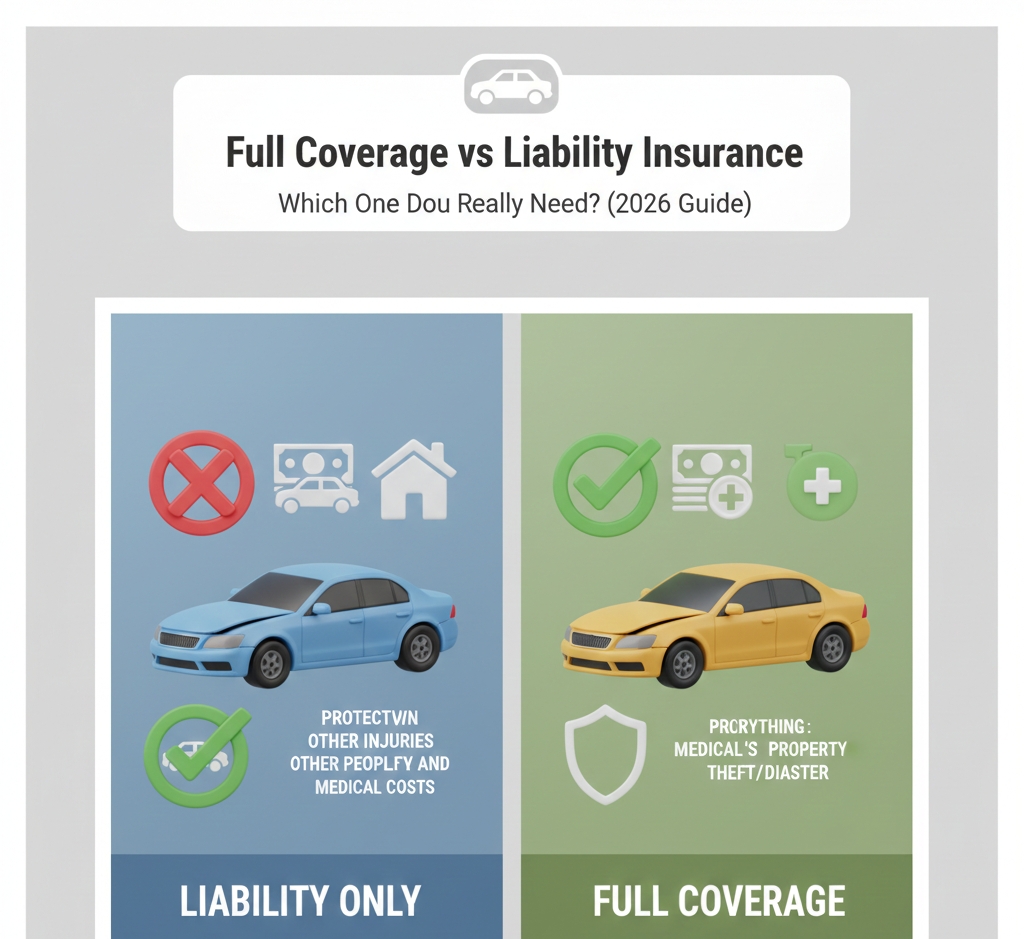
Choosing the right car insurance coverage is one of the most important financial decisions for drivers in the United States. Many people hear terms like full coverage and liability insurance but don’t fully understand the difference — or which one is right for their situation.
In this detailed 2026 guide, we’ll break down:
- What liability insurance covers
- What full coverage actually means
- Key differences
- Cost comparison
- Who should choose which option
- Frequently asked questions
Let’s simplify it step by step.
What Is Liability Car Insurance?
Liability insurance is the minimum legal requirement in almost every U.S. state.
It covers damage you cause to others, not your own car.
Liability Coverage Includes:
- Bodily Injury Liability (BI)
Pays for medical expenses, lost wages, and legal fees for the other party if you cause an accident. - Property Damage Liability (PD)
Pays for repairs to another person’s vehicle or property.
Example: If you hit another driver and cause $25,000 in damage, your liability insurance pays up to your policy limits.
However — your own car repairs are NOT covered.
What Is Full Coverage Car Insurance?
“Full coverage” is not a single policy. It is a combination of:
- Liability insurance
- Collision coverage
- Comprehensive coverage
What It Covers:
✔ Damage to other vehicles (liability)
✔ Damage to your car from accidents (collision)
✔ Theft, fire, vandalism, natural disasters (comprehensive)
If your car is financed or leased, lenders usually require full coverage.
Key Differences Between Full Coverage and Liability
| Feature | Liability Only | Full Coverage |
|---|---|---|
| Covers other drivers’ injuries | ✅ Yes | ✅ Yes |
| Covers other drivers’ property | ✅ Yes | ✅ Yes |
| Covers your car accident damage | ❌ No | ✅ Yes |
| Covers theft or natural disaster | ❌ No | ✅ Yes |
| Required by law | ✅ Yes | ❌ No |
| Required by lender | ❌ No | ✅ Yes |
Average Cost Comparison (2026 Estimates)
While prices vary by state and driver profile, general averages:
- Liability Only: $600–$1,200 per year
- Full Coverage: $1,500–$2,500 per year
Full coverage can cost 2–3 times more than liability insurance.
Companies like and often provide competitive pricing for both coverage types.
When Liability Insurance Makes Sense
Liability-only coverage may be suitable if:
- Your car is older (value under $4,000–$5,000)
- You can afford to replace your vehicle
- You want the lowest legal premium
- You have strong emergency savings
Example: If your car is worth $3,000 and full coverage costs $1,800 per year, it may not make financial sense.
When Full Coverage Is the Better Choice
Full coverage is recommended if:
- Your car is new or expensive
- You financed or leased your vehicle
- You cannot afford major repair costs
- You live in high-theft or high-accident areas
- You want financial peace of mind
If your $30,000 car is totaled and you only have liability insurance — you receive $0 for your loss.
Understanding Collision vs Comprehensive
Many drivers confuse these two.
Collision Covers:
- Crashing into another vehicle
- Hitting a tree or object
- Single-car accidents
Comprehensive Covers:
- Theft
- Fire
- Flood
- Hail
- Vandalism
- Animal damage
Both are included in full coverage.
State Minimum Requirements
Each U.S. state sets minimum liability limits.
Example format:
- 25/50/25 coverage
This means:
- $25,000 bodily injury per person
- $50,000 bodily injury per accident
- $25,000 property damage
Minimum coverage keeps you legal — but may not fully protect your assets in serious accidents.
Financial Risk Comparison
Let’s compare two scenarios:
Scenario 1 – Liability Only
You cause a $15,000 accident.
Insurance pays (within limits).
Your car repair: $8,000 out of pocket.
Scenario 2 – Full Coverage
Same accident.
Insurance pays for both other party and your car (minus deductible).
Risk level with liability-only is significantly higher.
How Deductibles Impact Full Coverage
Full coverage includes deductibles for collision and comprehensive.
Common deductible options:
- $500
- $1,000
Higher deductible = Lower monthly premium
Lower deductible = Higher premium
Choose a deductible you can comfortably afford.
Is Full Coverage Worth the Extra Cost?
Ask yourself:
- Could I afford to replace my car tomorrow?
- Is my car worth more than $8,000–$10,000?
- Am I financing this vehicle?
If the answer is yes to any of these, full coverage may be worth it.
How Insurance Companies Price Coverage
Major insurers such as:
- Progressive
- Allstate
- USSA
Price policies based on:
- Driving history
- Credit score (in most states)
- Location
- Vehicle type
- Claims history
- Mileage
That’s why comparing quotes is essential.
How to Decide the Right Option
Use this simple rule:
Car Value Rule:
If annual full coverage cost exceeds 10% of your car’s value, reconsider keeping it.
Example: Car value = $6,000
Full coverage premium = $1,500/year (25%)
→ Possibly switch to liability only.
Pros and Cons Summary
Liability Insurance
Pros:
- Cheapest option
- Meets legal requirements
- Simple coverage
Cons:
- No protection for your vehicle
- High financial risk
Full Coverage
Pros:
- Maximum protection
- Covers theft and disasters
- Required for financed cars
Cons:
- Higher premium
- Deductible required
Frequently Asked Questions (FAQ)
1. Is full coverage required by law?
No. Only liability insurance is required by state law. However, lenders require full coverage for financed vehicles.
2. Can I switch from full coverage to liability?
Yes, if your car is fully paid off. Contact your insurer to adjust your policy.
3. Does full coverage cover mechanical breakdown?
No. It does not cover engine or transmission failure unless caused by an accident.
4. Is liability insurance enough protection?
It depends on your car’s value and financial situation. It protects others, not your own vehicle.
5. What happens if my car is stolen with liability-only coverage?
You receive no payout. Theft is covered under comprehensive coverage.
6. How much more expensive is full coverage?
Typically 2–3 times more than liability-only insurance.
7. Should I drop full coverage on an older car?
If repair or replacement cost is low and you can afford the risk, it may make financial sense.
Final Thoughts: Protection vs Price
Choosing between full coverage and liability insurance isn’t just about price — it’s about risk management.
If your car is valuable or financed, full coverage provides strong financial protection.
If your vehicle is older and affordable to replace, liability-only may be the smarter, cost-effective option.
The best strategy?
Compare quotes, calculate your vehicle’s value, and choose coverage that balances affordability with protection.